Unos Decision Intelligence

Decision intelligence

Stop reading dashboards. Start making decisions.

Every number arrives with the short list of who or what to act on, the person who owns it, and a record of what happened next.

Scroll to follow one decision at a retail chain

Retail chainAct today

Weekend stock-out risk

32lines to reorder across 6 stores before Saturday
01Store 3 · fresh milk · sells out by Saturday noonReorder
02Store 5 · nappies · promotion starts FridayReorder
03Store 1 · bottled water · heatwave forecastTransfer
Approve 32AdjustOverride
Owner: Head of Store OperationsOutcome measured after the weekend

Why now

You have the data. The decisions still happen by gut.

Reports

Nobody acts on them

Dashboards show what happened. They rarely say who should do what, by when, or whether it worked.

Versions

Every team has its own number

Finance, operations and the board each pull the figure differently, so meetings argue about the data instead of the decision.

Pilots

AI that never reaches the floor

Models get built, then sit beside the business. Without a governed path to action, they stay experiments.

How it works

Many systems in. One governed model. The same number everywhere.

Your existing systems stay where they are. We bring their data into one model of the business, and every screen, chat answer and alert reads from it. Shown here for the same retail chain.

Point of salePOSStockWMSSuppliersEDIPromotionsPromoLoyaltyCRMFinanceERPOne governed modeldefined once · access by roleCommand Centerexecutives= 32 linesAsk in plain wordschat= 32 linesAI assistantsgoverned= 32 linesAlertsfrontline= 32 lines POSWMSEDIPromoCRMERPOne governed modeldefined once · access by roleCommand32Chat32AI agents32Alerts32
One definitionSales, stock cover or sell-through is defined once, and nobody re-derives it in a spreadsheet.
Every surfaceExecutives, frontline teams and AI assistants see the same figure, by construction.
Governed accessPeople see only what their role allows, wherever they ask the question.
SENSEPREDICTDECIDEACTLEARNOne decision, end to endStock-out risk

The closed loop

A decision isn't done until the outcome comes back.

01 · Sense

Spot what changed

Sales, stock counts, deliveries and promotions flow in daily from the systems you already run.

Example. Weekend sales up 18% in six stores, with a heatwave forecast.

02 · Predict

Score what is at risk

Each product in each store gets a stock-out risk with the reasons behind it, so the score can be challenged, not just trusted.

Example. 32 lines score high, mostly promotions starting Friday and late deliveries.

03 · Decide

Put it in front of the owner

The Head of Store Operations sees one card: the number, the worklist and the recommended action. They approve, adjust or override.

Example. Approves 30 reorders, overrides 2 where a transfer from a nearby store is faster.

04 · Act

Send it where work happens

The approved action goes to the ordering system, store task list or messaging tool your team already uses, tagged with a decision ID.

Example. 30 purchase orders go to suppliers; 2 transfers land in store task lists.

05 · Learn

Measure what actually happened

Outcomes are recorded against the same decision ID and compared with a held-out group, so you learn what worked, not what correlated.

Example. After the weekend: stock-outs in these six stores against held-out stores.

A person approves every action. Nothing runs on autopilot.

Beyond retail

Same method, any industry. Decisions at the core.

So far you have followed one retail decision. The method does not change by industry: we start from the decisions your executives own, not from the data you happen to have. Below are examples from industries we have worked in, and your solution is shaped around your own decisions.

Hospital corridor in black and white, with an example decision: 14 discharged patients to call before Friday

Healthcare

From intake to discharge to the 30 days after.

Hospital groups and specialist centres: patient flow, revenue cycle and the follow-up that keeps patients from coming back.

Examples, not a limit. We model the decisions you name.

Access & intake · CEO

  • Appointment no-show prevention
  • Intake triage by acuity
  • Payer mix stabilisation

Care delivery · CMO

  • Deterioration early warning
  • High-risk medication alerts
  • Discharge completeness

Capacity & logistics · COO

  • Emergency department balancing
  • Nurse scheduling
  • Equipment maintenance forecast

Revenue cycle · CFO

  • Claims denial interception
  • Payer underpayment recovery
  • Cash runway scenarios

The decision library

Not dashboards. Decisions, each with an owner.

Claims denial interceptionMarkdown optimisationAircraft swaps30-day readmissionSite selectionPredictive maintenanceNo-show preventionReplenishmentOvernight rate movesNurse schedulingSize & colour curvesYour next decision
Catchment healthDeterioration early warningScrap root causeChurn & reactivationEmergency department balancingDynamic overbookingInter-store rebalancingUnderpayment recoveryChangeover minimisationPrice elasticityAttrition early warningWhich account to chase

Said honestly

Some decisions prove themselves overnight. Others take a year.

Hotel room-rate moveovernightFast
Fresh-food markdown1 dayFast
Store replenishment orderdaysFast
Apparel markdown2–6 weeksMedium
30-day readmission30 daysMedium
New site selection12–24 monthsOne-off

Without a holdout, you measure correlation

Proving a decision worked needs a control: a held-out set of stores, wards, properties or dates. Fast decisions are learned from; slow and one-off decisions are tracked. We tell you which is which before you start.

Proof

Built and running. Not a slide deck.

1governed model behind every screen, chat answer and alert
100%of actions approved by a person and kept on record
6 wksto your first decision live on your own data
2 wksfrom brief to a working model for a new industry

Medical devices manufacturer

Employee healthcare costs, finally visible

Clinic visits, medical leave and claims brought into one model, so HR and finance can see where the money goes and which departments are trending up.

Government agency

A monthly report that writes itself

Medical claims reporting that used to be compiled by hand now comes out of the platform as a finished presentation and PDF, for whichever period the user picks.

Client names withheld. Examples on this page are illustrative; your solution is built on your data, around your decisions.

On record

Every action approved. Every outcome on record.

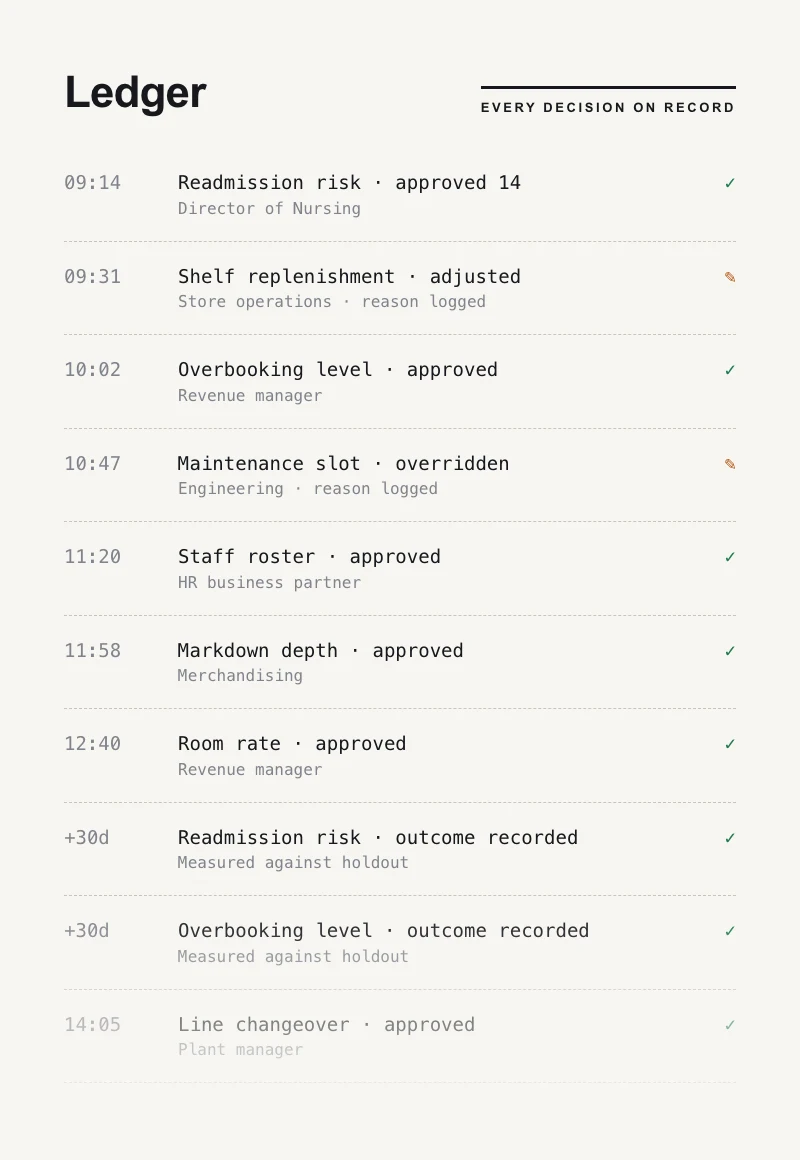
Decision intelligence you can audit. Each recommendation shows its reasons, each action carries the name of the person who approved it, and each outcome is measured against what would have happened anyway.

  • Approved by a personApprove, adjust or override, with the reason kept.
  • Access by rolePeople see only what their role allows, on every screen and in every chat answer.
  • Ready for auditWho saw what, who approved what, and when, for your internal audit and data-protection reviews.
A decision ledger: timestamped entries showing decisions approved, adjusted or overridden, by whom, and outcomes recorded 30 days later against a holdout

Getting started

Start with three decisions, not a transformation programme.

Weeks 1–2

Choose and check

We pick three decisions with your executives and check, honestly, whether your data can support each one.

Weeks 3–6

First decision live

The first decision runs on your own data, in front of its owner, with the worklist and the outcome tracking in place.

Then

One decision at a time

Each new decision reuses the same model, so it costs less than the last. You decide what comes next.

Book a demo

See your first decision in 30 minutes.

Prototype: the booking button is a placeholder until a contact address is confirmed.

  • 01We walk through the platform for your industry.
  • 02You name the decisions that keep you up at night.
  • 03We tell you which ones your data can support today.